Hugo vs Etch Studio: Thirteen Years Old, Still Free
One Go binary turns a folder of Markdown into a static site. Apache 2.0, released every few weeks, and no subscription.
Etch Studio costs $590 a year on the annual plan, or $708 if you pay monthly.
Hugo costs nothing. Its homepage says it’s “open source and free to use”, under the Apache 2.0 licence. It has been around since 2013, and it’s still being worked on: v0.169.0 came out on 27 October 2026.
One binary, one folder
Hugo is a single program written in Go. On a Mac it’s brew install hugo. There are prebuilt binaries for Windows, Linux and BSD too.
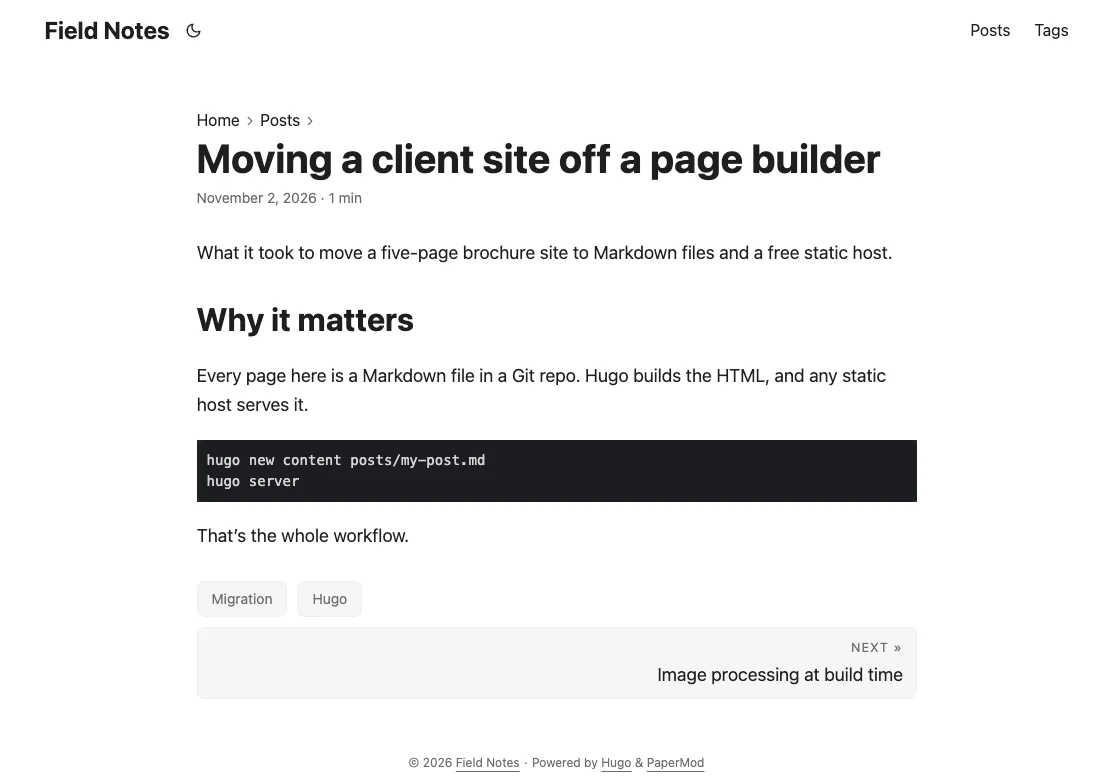
Your site is a folder. Pages are Markdown files in content/, layouts are templates in layouts/, and running hugo writes plain HTML into public/. That folder is your website.
It all goes in Git. There’s no database and no account, and you can read a diff of what changed.
Fast is the whole pitch
Hugo calls itself “the world’s fastest framework for building websites”. Its homepage says it “renders a large site in seconds, often less.”
More built in than you’d guess
Hugo isn’t just Markdown to HTML. Out of the box you get:
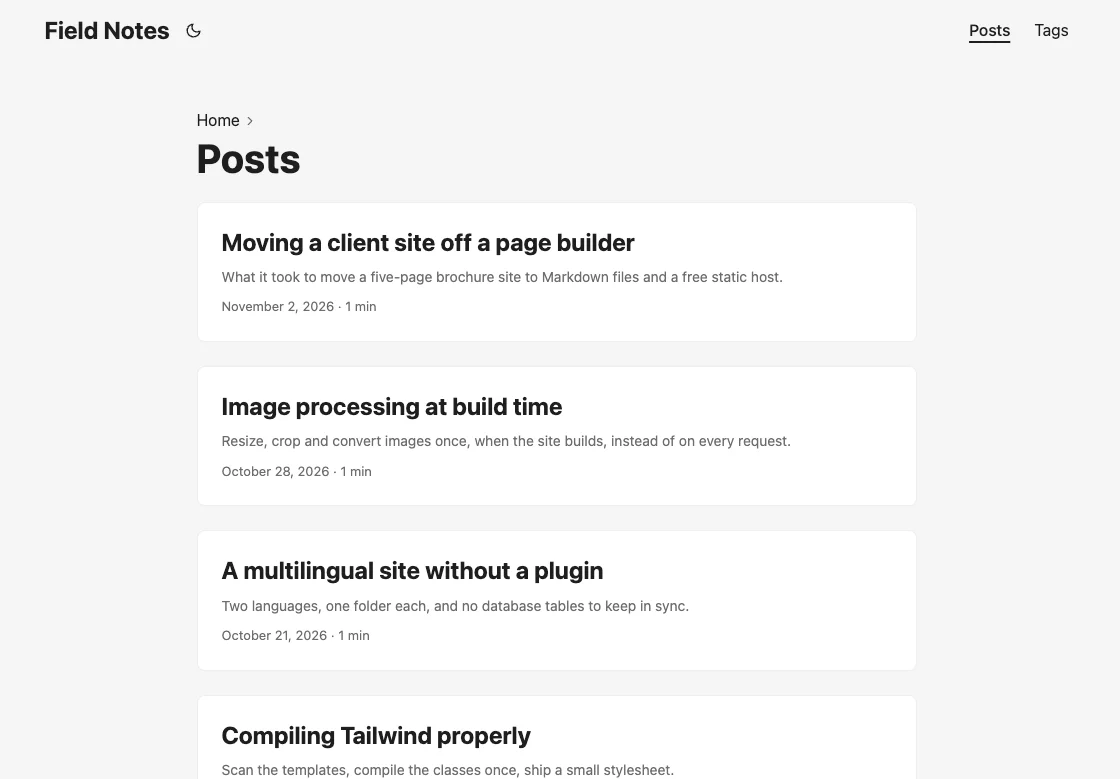
- Images resized, cropped and converted at build time, with the results cached.
- Multilingual sites, with translations, dates and currencies per language.
- Taxonomies, so tags and categories need no plugin. A new project already writes an RSS feed and a sitemap.
- Tailwind, compiled properly. The
css.TailwindCSSdocs say it scans your templates and compiles the classes “into standard CSS”. Nothing gets built in the visitor’s browser.
Content doesn’t have to be Markdown, either. Hugo also reads HTML, AsciiDoc, Org Mode, Pandoc and reStructuredText.
Host it anywhere
The output is static files, so any host works. Hugo’s docs have guides for Cloudflare, Netlify, Vercel, GitHub Pages, GitLab Pages, Codeberg Pages, AWS Amplify, Azure, Firebase and Render, plus FTP and rsync to your own server.
The Homebrew build can also push straight to an S3, Google Cloud or Azure bucket with hugo deploy.
No visual builder, no AI, no problem
Hugo has no drag-and-drop canvas and no AI assistant. If dragging sections around is the reason you looked at Etch Studio, Hugo isn’t that.
But the whole site is text files. Your own agent can write the Markdown, edit the templates and run the build, the same as any other code. You’re not paying a builder $590 a year to sit between you and the files.
Thirteen years of releases
Hugo’s version number still starts with a 0. Don’t read that as unfinished. It’s been in use since 2013, and it ships a release every few weeks.
Pin the Hugo version for each project and read the release notes before you upgrade, as you would with any tool you rely on.
Templates use Go’s syntax, such as {{ range .Pages }}. A new project has no theme, so either write your own layouts or start from one on the themes site.
Shops and logins? Etch Studio can’t do them either
Hugo builds static files. A shop or member logins mean adding a third-party service.
Etch Studio is no different. Its own FAQ says Studio “compiles your site into lightweight static files and pushes it live to Cloudflare.” For logins or a shop, the same FAQ sends you back to WordPress: “user login systems, or e-commerce through WooCommerce, SureCart, or a similar platform.” On publishing to Shopify, all it offers is “There could be a day”.
So Etch Studio charges $590 a year for a static site with the same limits Hugo has for free.
Who it’s for
Developers who want a fast, free generator that’s been around long enough to trust. It’s especially good for docs, blogs, and big multilingual sites.
If you’d rather write components in JavaScript, I’d pick Astro. If you want one binary, and no node_modules folder unless you add Tailwind, Hugo is the better fit. Either way, you’re not paying Etch Studio’s $590 a year.